
Calendars for celebrations: organize events and create joy
TL;DR:
- Calendars have historically been vital for community and family celebrations, fostering shared traditions.
- Using shared and personalized calendars improves celebration attendance, reduces stress, and strengthens bonds.
- Incorporating cultural, religious, and personal notes into calendars enhances meaningfulness and planning consistency.
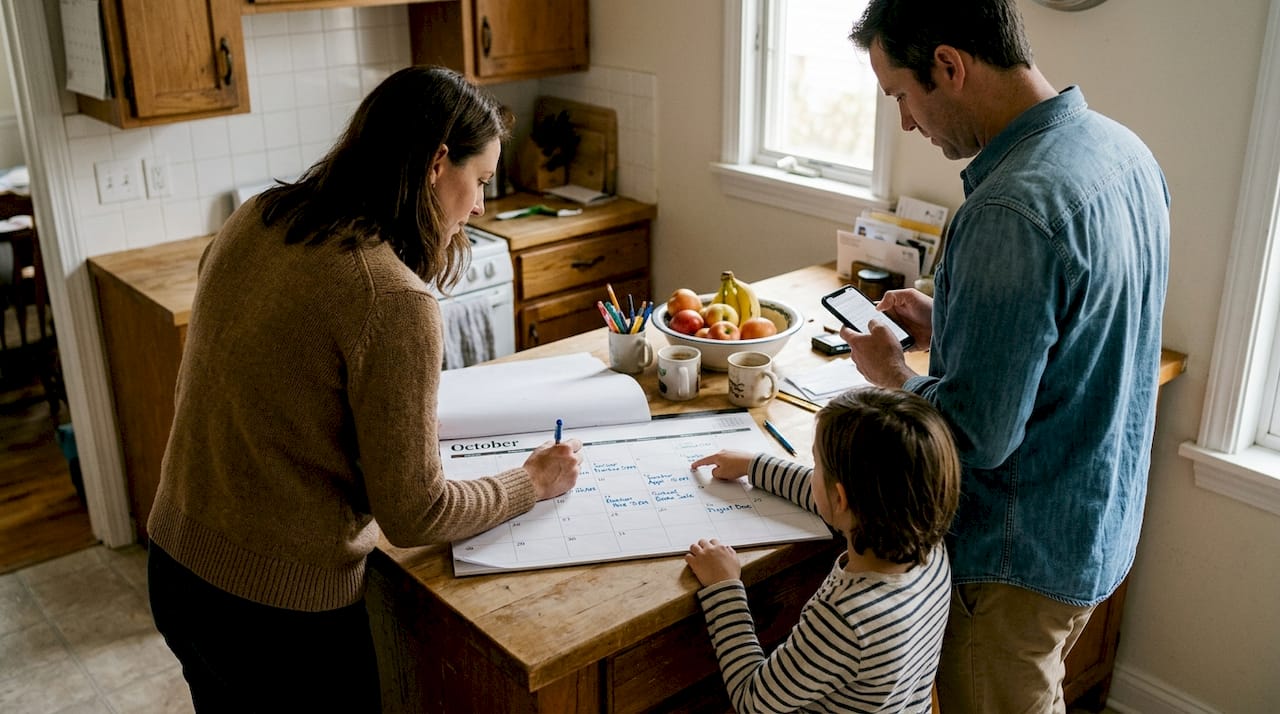
Most people think of calendars as tools for tracking work deadlines or doctor appointments. But calendars are quietly one of the most powerful tools for building a joyful, connected family life. When you use them intentionally for celebrations, something shifts. Planning becomes less stressful. Attendance goes up. People feel more valued. This article walks you through the history, science, and practical strategies behind using calendars for celebrations, so you can stop scrambling before every birthday or holiday and start building traditions that actually stick.
Table of Contents
- What most people miss about using calendars for celebrations
- Take your celebration planning to the next level
- Frequently asked questions
Key Takeaways
| Point | Details |
|---|---|
| Calendars build tradition | Calendars help families and communities create and sustain celebration rituals year after year. |
| Better organization | A well-planned celebration calendar simplifies scheduling, boosts attendance, and reduces stress. |
| Personalization matters | Custom calendars empower you to tailor events and reminders for your unique family needs. |
| Mindfulness and connection | Using calendars for celebrations encourages thoughtful planning and strengthens relationships. |
From ancient traditions to modern celebrations: Why calendars matter
Calendars didn’t start as productivity tools. They started as survival tools, then became celebration tools. Early civilizations needed to know when the seasons changed, when to plant crops, and when to gather. Those gathering moments became rituals, and those rituals became celebrations that repeated year after year.
Calendars originated to track astronomical cycles like solstices and equinoxes, enabling societies to mark and celebrate seasonal festivals consistently across generations. That’s not a small thing. It means the very purpose of a calendar, from the beginning, was to help communities show up together for meaningful moments.
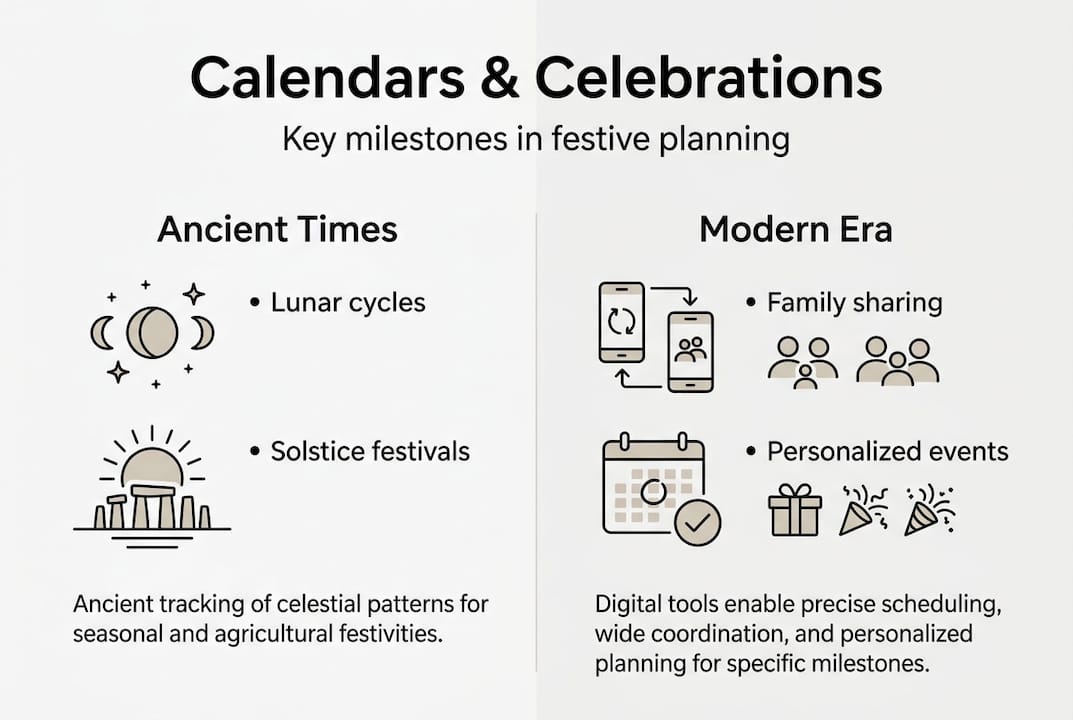
The Zagmuk festival, one of the oldest recorded celebrations, was tied directly to the Babylonian calendar and the winter solstice. Communities would gather based on a shared understanding of where they were in the year. Without that shared structure, the celebration simply couldn’t happen.
Here’s a quick look at how calendar systems evolved alongside human celebrations:
| Era | Calendar type | Key celebrations enabled |
|---|---|---|
| Ancient Babylon | Lunar | Zagmuk, harvest festivals |
| Ancient Egypt | Solar | Flooding of the Nile, royal ceremonies |
| Medieval Europe | Julian | Easter, Christmas, saint’s days |
| Modern era | Gregorian + digital | Birthdays, holidays, custom events |
The Nisan calendar cycles used in ancient Mesopotamia show how carefully people tracked time to protect the integrity of their celebrations. Missing a festival wasn’t just inconvenient. It was culturally significant.
What this history tells us is important: the calendar and the celebration are inseparable. One gives the other meaning. When you mark a birthday on your calendar, you’re participating in a tradition that goes back thousands of years.
Key reasons why calendars have always mattered for celebrations:
- They create a shared reference point for communities and families
- They build anticipation by making future events visible
- They protect time before it gets claimed by other obligations
- They transform one-time events into repeating traditions
- They give celebrations cultural and emotional weight
“A calendar is not just a record of time. It is a map of what a community values enough to celebrate together.”
Modern customizable calendars carry this same power. They just give you far more control over how you use it.
Consistency and global coordination: How calendars organize celebration dates
One of the biggest challenges families face today is coordination. You might have relatives across different states or even different countries. Someone works weekends. Someone else observes different holidays. Without a shared calendar structure, celebrations fall apart before they even start.
Calendars standardize celebration dates, allowing global coordination for holidays like New Year’s, Christmas, and cultural events that span continents. That standardization is what makes it possible for a family in Texas and a family in Germany to plan a shared video call celebration on the same day.
Here’s a look at how different types of celebrations benefit from calendar coordination:
| Celebration type | Coordination challenge | Calendar solution |
|---|---|---|
| Family birthdays | Different time zones | Shared digital calendar with alerts |
| Religious holidays | Varying dates by year | Auto-add by country or religion |
| Cultural festivals | Local vs. global timing | Custom notes with regional dates |
| Work anniversaries | Easily forgotten | Recurring annual reminders |
Beyond family coordination, social media holidays have created an entirely new layer of celebration opportunities. National Taco Day, World Kindness Day, and hundreds of similar observances give families and communities fun, low-effort reasons to gather or connect.
A practical approach to building a well-rounded celebration calendar:
- Start with major public holidays for your country
- Add personal milestones: birthdays, anniversaries, graduations
- Include cultural or religious observances your family observes
- Layer in fun observances and monthly awareness events that match your interests
- Set reminders two to four weeks before each major celebration
Stat to know: Families that use shared calendars report significantly fewer scheduling conflicts and higher participation in planned events, especially when reminders are set in advance.
The key insight here is that coordination isn’t just logistical. It’s emotional. When everyone knows a celebration is coming, they can mentally prepare, make travel plans, buy gifts, and show up fully present.
Customization and personalization: Making celebration calendars work for you
A generic calendar is better than nothing. But a personalized calendar is a completely different tool. When your calendar reflects your actual family, your actual traditions, and your actual priorities, it stops being a scheduling grid and starts being a living record of what matters to you.
Customizable calendars with color-coding, notes, and shared formats enable real personalization for family use, with practical strategies like weekly syncs and batch updates making the habit sustainable.

Color-coding is one of the simplest and most effective personalization strategies. Assign one color to birthdays, another to anniversaries, another to school events, and another to holidays. At a glance, you can see the emotional texture of your month. A month with lots of birthday colors feels different from a month with mostly work colors.
Here are the most effective personalization strategies for celebration calendars:
- Color-code by category: Birthdays, holidays, anniversaries, and cultural events each get their own color
- Add personal notes: Include gift ideas, party themes, or food preferences directly on the date
- Use recurring events: Set birthdays and anniversaries to repeat automatically every year
- Create family-specific holidays: Mark the day you adopted your pet, your family’s annual camping trip, or a personal tradition
- Share the calendar: When everyone in the family can see it, everyone feels included in the planning
People who use paper calendars at home often report stronger habits around planning and a deeper sense of ownership over their time. There’s something about writing an event by hand that makes it feel more real.
Pro Tip: Do a monthly “celebration preview” at the start of each month. Spend five minutes looking at every upcoming event, confirming details, and adding any prep tasks you need to complete. This one habit eliminates most last-minute scrambling.
Personalization also means knowing what to leave out. Not every day needs to be a celebration. The calendar works best when special days stand out clearly against ordinary ones.
The benefits: Better attendance, less stress, and deeper bonds
Here’s where the practical payoff becomes undeniable. Using calendars for celebration planning isn’t just about staying organized. It produces measurable improvements in how families and communities experience celebrations.
Calendars boost event attendance by 20 to 25% and reduce planning time by 40 to 67% through digital tools. The psychological benefits include anticipation that actually buffers stress rather than creating it.
That last point is worth sitting with. Most people assume that thinking about an upcoming event in advance creates anxiety. But research shows the opposite. Anticipation, when it’s structured and visible on a calendar, creates positive excitement. It gives people something to look forward to, which improves mood in the days and weeks leading up to the event.
Here’s a breakdown of the core benefits:
- Higher attendance: People who see an event on their calendar weeks in advance are far more likely to show up than those who receive last-minute invitations
- Reduced cognitive load: When celebrations are pre-planned, your brain stops carrying the mental weight of “I need to remember that”
- Better preparation: More lead time means better gifts, better food, and more thoughtful gestures
- Stronger relationships: Families that celebrate together consistently report higher levels of connection and trust
- Less guilt: When you’ve planned ahead, you don’t feel bad about missing something you forgot
Stat to know: Planning time for celebrations drops by nearly half when families use structured calendar tools with reminders and shared access.
Pro Tip: Set a two-stage reminder for important celebrations. The first reminder, three to four weeks out, is for logistics like ordering gifts or booking venues. The second reminder, three days out, is for final prep like writing a card or confirming attendance.
The emotional dimension here matters as much as the logistical one. When your family knows that birthdays are always celebrated, that anniversaries are never forgotten, and that holidays are planned in advance, it signals something powerful: these moments matter to us.
Edge cases: Navigating paper, digital, and cultural calendar differences
Not every celebration fits neatly into a standard calendar. This is where many families run into friction, and where a little extra awareness goes a long way.
Religious and cultural calendars create real complexity, with varying lunar and solar systems changing celebration dates year to year. Easter, for example, falls on a different date every year. Eid follows the Islamic lunar calendar. Diwali shifts annually on the Hindu calendar. If your family observes any of these, you can’t just set a fixed annual reminder.
Differences in how communities celebrate the same holidays can also affect when and how you plan. Two branches of the same family might celebrate Christmas on December 24th or December 25th, or both.
Key edge cases to plan for:
- Lunar calendar holidays: Check the date each year and update your calendar manually
- Multi-timezone families: Use digital calendars that display events in each person’s local time
- Blended family traditions: Create a master calendar that includes celebrations from all cultural backgrounds
- Floating holidays: Some workplace or national holidays shift to the nearest Monday, which affects planning
The psychology of paper calendars reveals something interesting: people who write events by hand tend to engage more mindfully with their time. They’re less likely to double-book and more likely to protect the time they’ve marked as important.
“The format of your calendar shapes how you experience time. Paper makes time feel tangible. Digital makes it flexible. The best approach uses both.”
For most families, a hybrid approach works well. Use a digital calendar for coordination and reminders, and keep a printed or paper calendar in a shared space at home for visibility and mindful engagement.
What most people miss about using calendars for celebrations
Most people treat a calendar as a reminder system. Set the date, get the notification, show up. That’s useful, but it misses the deeper value entirely.
A celebration calendar is actually a values document. Every event you choose to mark says something about what your family prioritizes. When you add your grandmother’s birthday, your child’s first recital, and your cultural heritage festival to the same calendar, you’re building a record of identity. Not just a schedule.
The families who get the most out of celebration calendars aren’t the ones with the most events marked. They’re the ones who use the calendar to protect time intentionally. They block out the week before a big celebration for preparation. They add notes about what made last year’s party special. They treat the calendar as a living document, not a static grid.
Paper formats deserve more credit here. Writing a celebration by hand, seeing it on the wall every day, and physically crossing off the days until it arrives builds genuine anticipation. That anticipation is part of the celebration itself.
The real shift happens when you stop asking “what do I need to remember?” and start asking “what do I want to protect?”
Take your celebration planning to the next level
You now have the history, the strategy, and the psychology behind using calendars to build richer, more connected celebrations. The next step is putting it into practice with a tool that actually fits your needs.
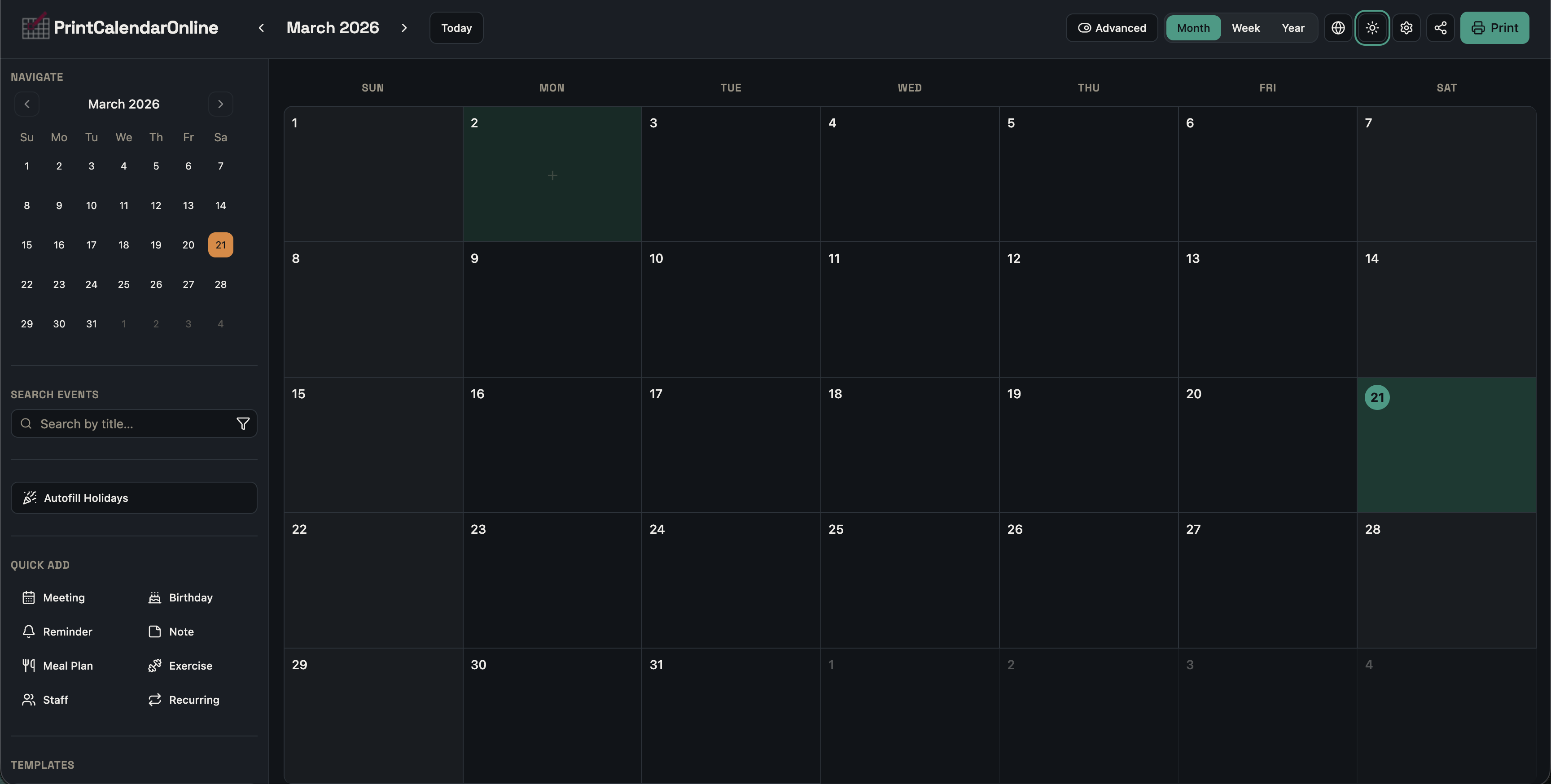
With print-calendar-online.com, you can create customized calendars that reflect your family’s unique celebrations, cultural traditions, and personal milestones. Add birthdays, recurring holidays, and custom notes in Simple Mode for quick setup, or use Advanced Mode for full event management with categories and recurring events. You can automatically add public holidays for your country, personalize backgrounds, and print a calendar that lives on your wall as a daily reminder of what matters most. Start building your celebration calendar today.
Frequently asked questions
Do calendars really improve attendance for family celebrations?
Calendars boost attendance by 20 to 25% through better scheduling and advance reminders, giving people enough lead time to plan around the event.
What are the benefits of customizing celebration calendars?
Custom calendars enable real personalization for families, making it easier to visualize important dates, assign categories, and collaborate on planning across households.
How do cultural and religious calendars affect celebration planning?
Lunar and solar calendar differences shift celebration dates annually, meaning families observing holidays like Easter or Eid need to update their calendars each year rather than using fixed reminders.
Are paper calendars better for planning celebrations?
Paper calendars support mindfulness and memory, making planning feel more intentional, while digital calendars add convenience and sharing capabilities for coordinating across distances.